
The headline cost difference between offshore and domestic joinery supply is usually obvious. The full comparison — including freight, lead times, quality risk, and warranty implications — is where most developers stop doing the maths.
Here's an honest breakdown of what offshore joinery supply actually costs versus domestic, and where the numbers genuinely favour each option.
Where Offshore Supply Wins
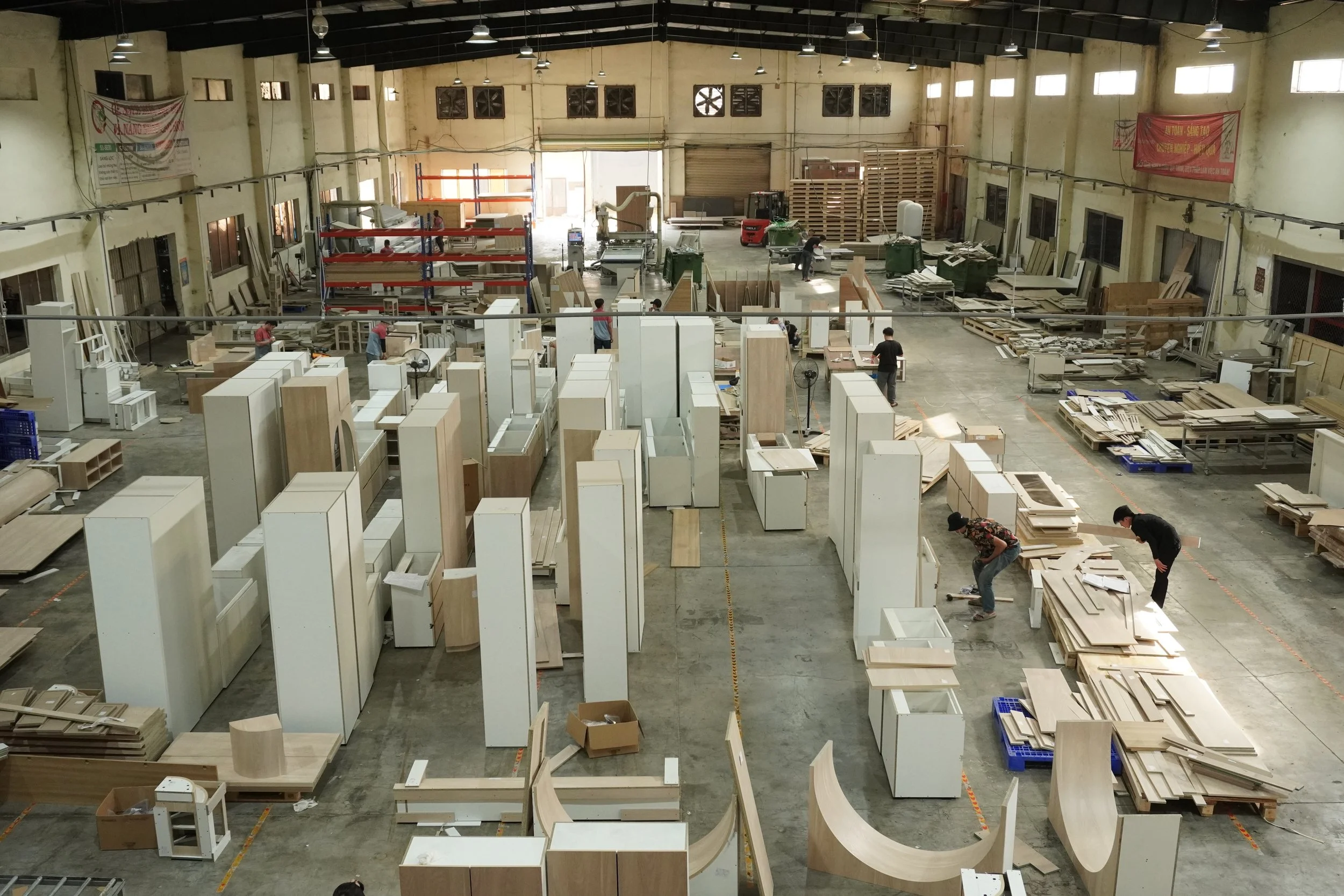
Unit cost. For volume production — kitchens and wardrobes at scale — offshore manufacturing in Vietnam delivers a significant per-unit cost advantage. Labour costs, overheads, and factory scale in a facility like Pacific Joinery's Ho Chi Minh City plant produce price points that domestic suppliers at equivalent quality simply cannot match.
Consistent output at volume. A domestic manufacturer running near capacity has less headroom to absorb a large order without timeline risk. A purpose-built export facility with 300+ kitchens per month in base capacity has structural headroom built in.
Hardware quality is not a trade-off. A common misconception is that offshore means downgraded components. Pacific Joinery specifies Blum, Hettich, and Häfele hardware — the same tier-one brands used in premium domestic fitouts. The cost advantage is in labour and manufacturing overhead, not in component quality.
Where Domestic Supply Has an Advantage
Speed on late changes. If your development programme shifts dramatically or you need a late variation, a domestic supplier can respond faster. The 4–8 week production window plus shipping time from Vietnam means that late variation requests have a real cost — either in premium air freight or in programme delay.
No freight cost or complexity. Domestic supply eliminates ocean freight, customs clearance, and port logistics. For very small orders or highly bespoke, low-volume work, the freight overhead can erode the unit cost advantage.
Easier site visits and in-person QC. Some developers and builders prefer being able to visit a factory in person. This is a real preference, not an irrational one — though Pacific Joinery's team is set up for remote QC documentation and has an established track record with export clients across the US, Canada, Australia, and NZ.
The Real Comparison: What It Looks Like on a 100-Unit Project
On a 100-unit residential development, the unit cost advantage of offshore supply — even after freight and logistics — typically produces a total joinery cost that is materially lower than domestic equivalents at equivalent specification. The exact figure depends on specification, market, and project timeline, but the gap is real and significant.
The risk cost (the risk of delay, defects, or specification failure) is where offshore supply used to carry a premium. With a manufacturer like Pacific Joinery — which was founded by the team behind Creador, a premium Australian joinery brand — that risk premium has been substantially reduced.
Want to run the numbers for your specific project? Reach out to Pacific Joinery for a project-specific conversation.
Get in touch to discuss your next project: