
Specifying kitchens for a single luxury home is a different exercise entirely from specifying kitchens for 150 apartments. The variables that barely register on a single fitout — finish consistency, hinge longevity, drawer tolerances, panel thickness variance — become major quality and warranty issues at scale.
Here's what experienced developers get right from the start.
Standardise Without Sacrificing Marketability
The temptation in volume development is to over-standardise: one kitchen layout, one finish, minimal options. The temptation on the other side is to offer too much variation to satisfy marketing — and then watch the production cost and coordination overhead balloon.
The right approach is smart standardisation: a base specification tight enough to produce reliably at volume, with limited, controlled variation options (two or three finish choices, for example) that give the market team what they need without breaking the production model.
This is where working with a manufacturer who has done it before matters. They'll tell you which variations add real cost and which ones don't — and that information is worth money.
Specify Hardware by Brand, Not Just Type
"Soft-close hinges" is not a specification. Blum Clip Top Blumotion is a specification. The gap matters: not all soft-close hinges are equal in durability, and in a 150-apartment development, even a modest failure rate on hinges becomes a costly post-handover warranty issue.
Specify hardware by brand and model number. Accept no substitution without written sign-off. Pacific Joinery uses Blum, Hettich, and Häfele hardware as standard — named brands your trades will know.
Resolve Board and Finish Specifications Early
Once production starts, changing a finish specification is expensive. Resolve all substrate, finish, and edge profile decisions before shop drawings are issued — not during production.
Confirm E1 or E0 formaldehyde ratings at specification stage if you're targeting green star or equivalent rating schemes. Pacific Joinery uses Panel Plus and FSC-certified boards with E1/E0 ratings as standard.
Plan for Site Conditions
Kitchens specified for apartments need to account for site conditions: lift dimensions, door opening widths, and stairwell clearances all affect how panels and carcasses are packaged and delivered. Confirm packing and delivery methodology with your supplier before production. Finding out a panel won't fit in the goods lift after it arrives on site is an avoidable and expensive mistake.
Lock in the Programme Before You Lock in the Price
The price you negotiate should include a realistic production timeline. Suppliers who give aggressive pricing with optimistic lead times often compress quality control at the back end. Get the programme in writing before the price is final — not after.
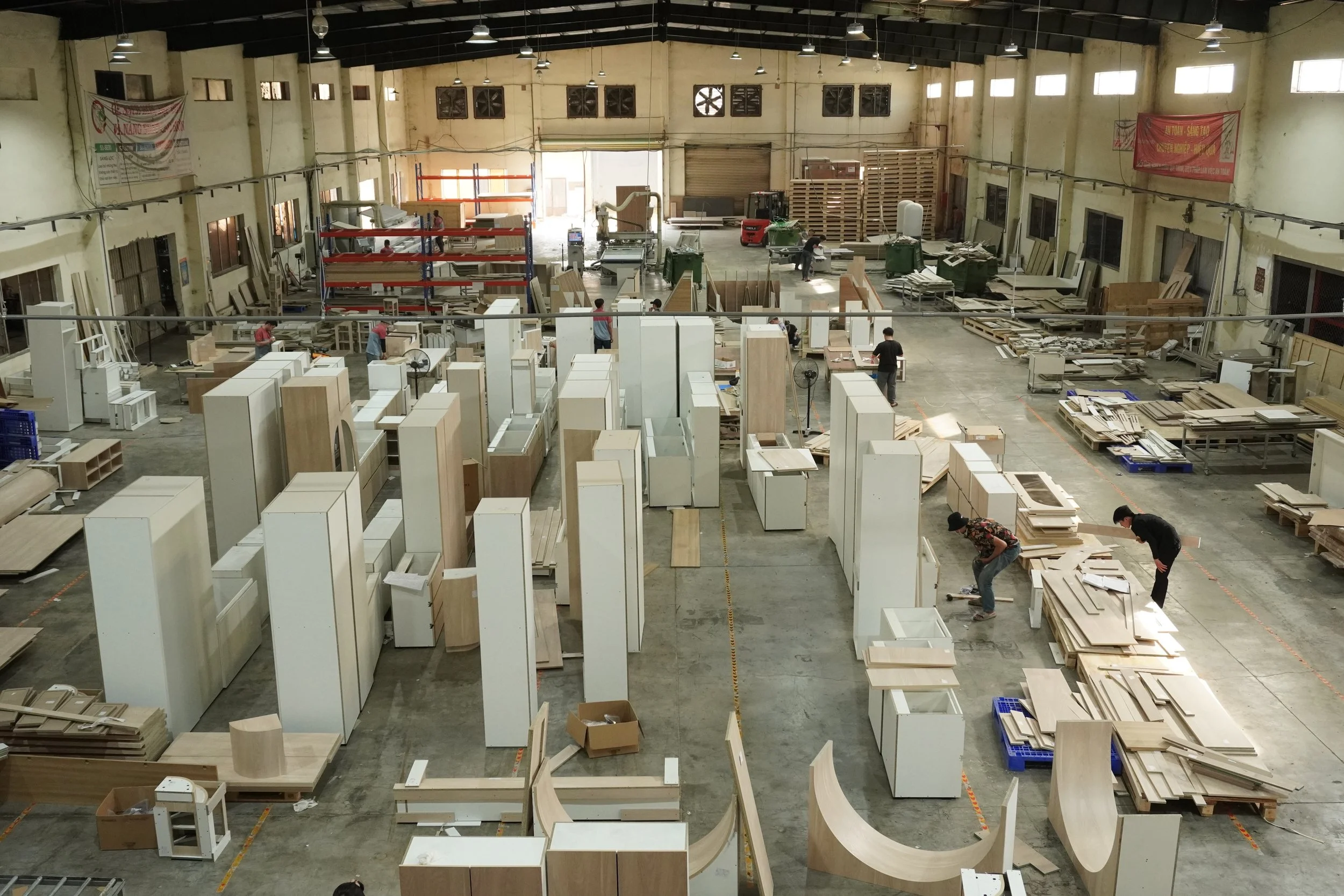
For large-scale residential projects, Pacific Joinery operates on a 4–8 week production window from sign-off, with consistent output at over 300 kitchens per month.
Getting the specification right before tender saves significant cost and time downstream. Talk to Pacific Joinery about your project brief.
Get in touch to discuss your next project: