
Not all joinery suppliers are built for volume. A business that does beautiful one-off residential work may have no viable path to supplying 200 apartments on a 10-week production window. The criteria that matter for a boutique fitout and the criteria that matter for a large development are fundamentally different.
If you're a developer or builder working on mid- to high-density residential projects, here's how to evaluate your joinery supplier properly — before the contract is signed.
1. Confirm Actual Production Capacity — Not Claimed Capacity
The first question to ask any supplier: what is your monthly output, and what does it look like when two major clients are running concurrently?
A supplier with a 50-kitchen monthly ceiling is not a viable partner for a 300-unit project, no matter how good their work is. Get a clear, documented figure for real production throughput — not theoretical peak capacity — and ask for evidence. Suppliers who've done it before can show it.
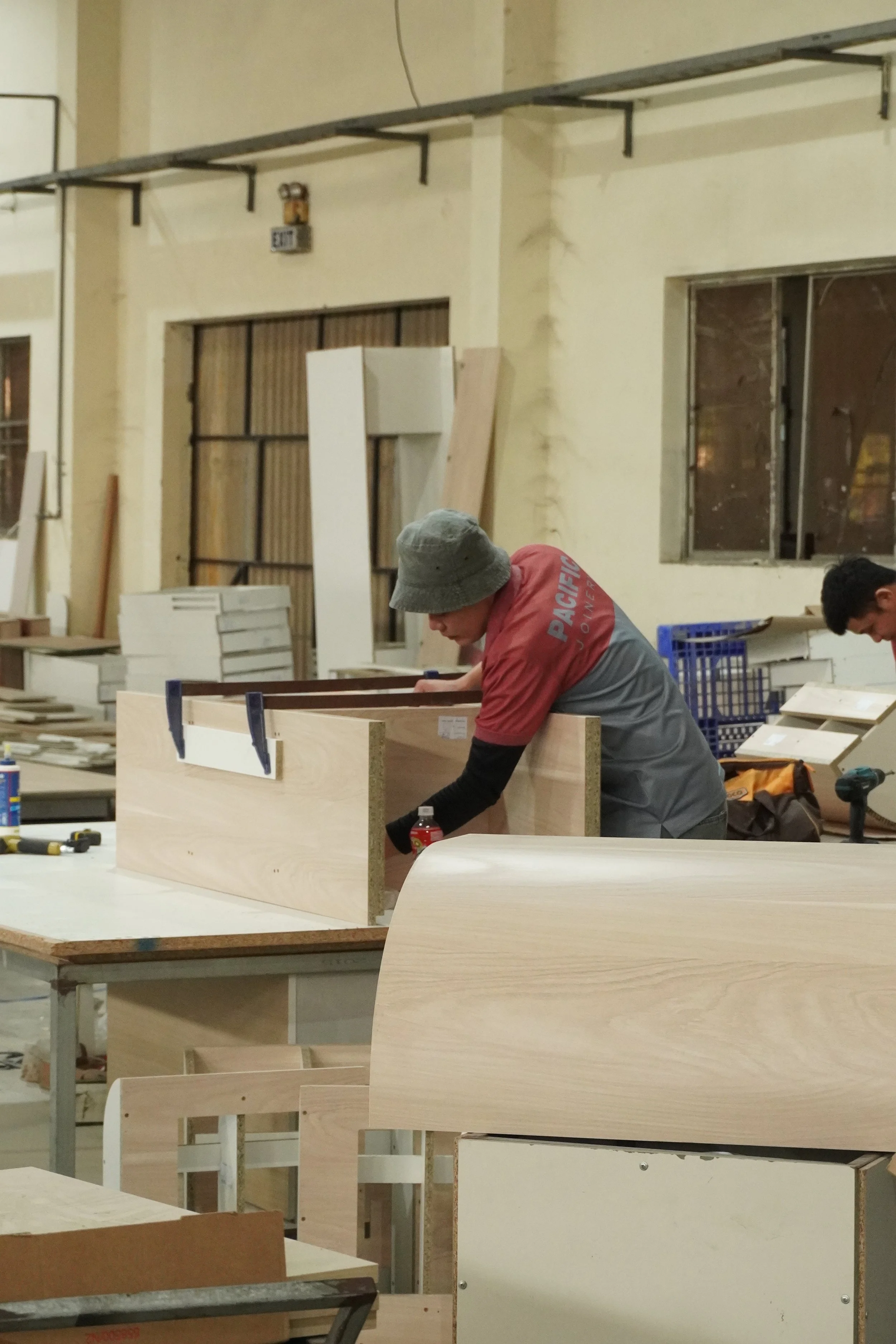
Pacific Joinery manufactures over 300 kitchens and 500 wardrobes per month from its Ho Chi Minh City facility. That's not headroom — that's a baseline.
2. Understand Their Design-to-Production Process
Volume joinery done well requires tight process discipline from the earliest design stages. Ask how the supplier handles design documentation, shop drawings, and variation management. If they're manually processing every revision, your project is a bottleneck waiting to happen.
The best joinery manufacturers operate more like precision manufacturers than cabinet makers. Systematic drawing review, standardised components where possible, and clear change control processes are the signs of an operation built for scale.
3. Verify Hardware and Material Specifications
At scale, what looks like a small component specification decision becomes a very large cost and quality variable. Confirm that the hardware brands being used — hinges, drawer systems, handles, closers — are from tier-one suppliers like Blum, Hettich, or Häfele. These brands provide consistent quality and are widely understood by site trades.
Similarly, confirm board specifications: E1 or E0 formaldehyde ratings, FSC certification if required, and surface material suppliers. Pacific Joinery uses Panel Plus and FSC-certified boards, with Corian, HI-MACS, and Forbo as surface options.
4. Assess Lead Times Relative to Your Programme
Joinery is almost always on the critical path of a residential development. Work backwards from your practical completion date and determine when shop drawings need to be signed off, when production needs to start, and when the container needs to leave the factory.
A 4–8 week production window plus shipping time — which varies by market — needs to be locked into your programme early, not negotiated at handover.
5. Ask About Quality Control Protocols
What does QC look like before goods leave the factory? How are defects identified, documented, and remediated? What is the supplier's policy on replacement and remediation once goods are on site?
A supplier confident in their quality will have clear, written answers to all three questions.
6. Understand the Relationship — Not Just the Transaction
The right joinery supplier is a project partner, not a vending machine. Do they understand how a development project runs? Have they worked with builders before — not just designers? Do they understand what a DA, a QS review, and a practical completion inspection mean?
The suppliers worth working with at scale have been on site. They know what happens when a panel is 2mm out. They've navigated it before, and they'll navigate it with you.
Choosing a joinery supplier is a high-stakes decision on any significant development. The criteria above won't guarantee a perfect outcome, but they'll filter out the suppliers who can't deliver before the damage is done.
If you're evaluating options for an upcoming project, contact Pacific Joinery to discuss your brief.

Get in touch to discuss your next project: