
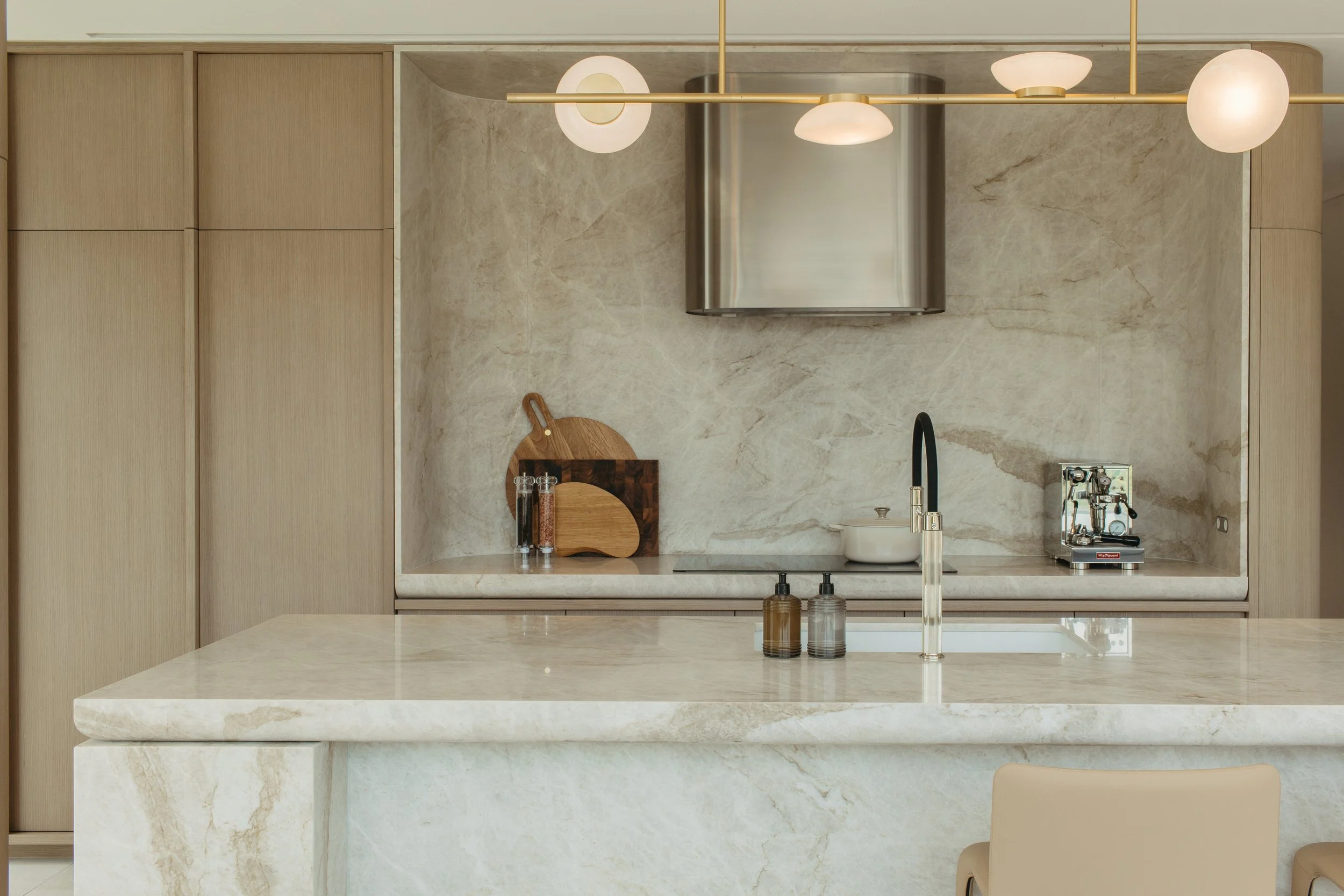
Veneer is one of the most refined surface finishes in joinery — offering the warmth of timber while maintaining stability and efficiency. However, not all veneers are made the same.
What is Natural Veneer?
Natural veneer is created by slicing or peeling thin layers from real timber logs. These slices are then dried, trimmed, and bonded onto stable panels.
How it’s made:
Carefully selected logs are softened using steam or hot water
Logs are sliced (flat-cut, quarter-cut, or rotary-cut)
Veneer sheets are dried and sorted by grain and tone
Sheets are pressed onto substrate panels using industrial adhesives
Key characteristics:
Authentic timber grain and variation
Each sheet is unique
Premium, organic appearance
Requires careful matching and craftsmanship
Natural veneer is ideal for high-end residential projects, feature joinery, and spaces where material authenticity matters.
What is Engineered (Hi-Tech) Veneer?
Engineered veneer — often called reconstituted or hi-tech veneer — is created by reshaping real timber fibers into consistent blocks before slicing.
How it’s made:
Fast-growing timber species are dyed and layered
Layers are compressed into blocks
Blocks are sliced into veneer sheets
Sheets are bonded to panels like natural veneer
Key characteristics:
Highly consistent grain and colour
Excellent yield and sustainability
Easier grain matching across large projects
Stable and predictable performance
Engineered veneer is widely used in commercial, hospitality, and large-scale residential projects where consistency is critical.
Which Veneer is Right?
Natural veneer → character, uniqueness, craftsmanship
Engineered veneer → consistency, scale, efficiency
At Pacific Joinery, we work with both — selecting the right veneer based on design intent, project scale, and long-term performance.
Get in touch to discuss your next project: