
Finish selection is where architects, builders and developers balance appearance, durability and budget. Each of the three main options has a legitimate place, and the right choice depends on the surface, the use and the market positioning of the project.
Timber Veneer
A veneer is a thin slice of real timber (typically 0.5mm to 0.6mm) bonded to a stable substrate such as MDF or plywood.
Strengths
Authentic timber appearance and feel
Dimensionally stable, because the substrate controls movement
More efficient use of premium timber, which can improve sustainability credentials
Allows matching techniques such as book-matching and slip-matching across large panels, a hallmark of premium work
Can be finished with natural oils, stains or clear lacquers
Limitations
Cannot be sanded back repeatedly like solid timber
Edges need careful detailing (timber edge strips, or matched veneer edge-banding)
Colour and grain vary between flitches, so panels need to be matched from the same source
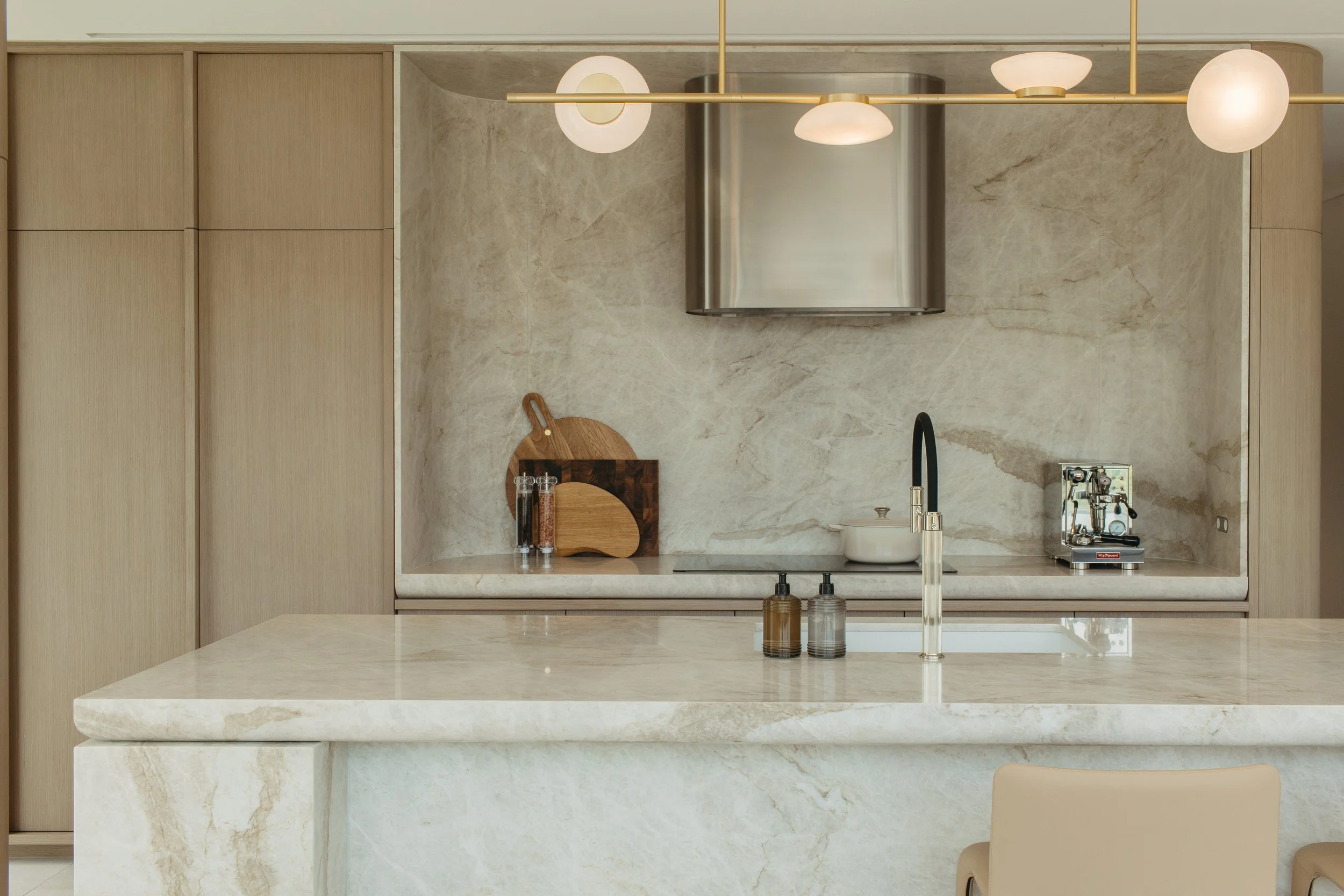
Best for: feature joinery, wardrobes, doors, wall panelling and kitchens in premium apartments and homes.
Solid Timber
Strengths
Can be sanded and refinished multiple times
Substantial feel and visible solid edges
Ideal for components that take wear and impact, such as stair treads, benchtops and door frames
Limitations
Moves with humidity, which creates cupping, gaps and cracking if poorly detailed
Higher material cost and more waste in producing wide panels
Species supply and certification vary
Best for: stair treads, handrails, frames, feature tables, benches and edge details.
Laminate
High-pressure laminate (HPL) and low-pressure melamine are printed or coloured surfaces bonded to a board substrate.
Strengths
Excellent durability and scratch, moisture and stain resistance
Consistent colour across large orders, which is valuable for multi-residential repeatability
Cost efficient, with a vast range of finishes
Modern textured and "timber-look" laminates offer convincing realism
Limitations
Cannot be repaired invisibly if chipped
Printed grain repeats, which can be noticeable on large panels
Perceived as lower-end in luxury contexts if poorly detailed
Best for: back-of-house, wet areas, high-traffic joinery, mid-market apartments and cost-sensitive volume work.
Mixing Finishes: How Premium Projects Do It
Premium projects rarely use one finish everywhere. A common, effective strategy:
Veneer on visible faces of doors, wardrobe fronts and feature joinery
Solid timber for edges, handrails and stair treads
Laminate inside carcasses, in laundry joinery and in back-of-house areas
This approach concentrates budget where it is seen and touched, while keeping the overall cost controlled.
Specification Tips
Specify species, cut (rift, quarter, crown), matching method and finish sheen for veneer, not just "oak veneer"
Approve a physical sample from the actual production flitch, not a catalogue chip
Confirm sustainability documentation (such as FSC) for timber veneer and solid timber. See our FSC guide
Plan a consistent finishing regime so doors, panels and stair components from different suppliers match
The Bottom Line
Veneer, solid timber and laminate are tools, not rivals. Use real timber where it is seen and handled, and durable laminate where performance matters most. The best-looking projects make deliberate decisions about each surface.
Request material samples of veneers, finishes and laminates for your next project.
Get in touch to discuss your next project: